Mike’s Story
A Multiple System Atrophy (MSA) community interview with Mike and Colleen from Reston, VA
It is difficult, at best, to put into words the enormity of the everyday life challenges a patient living with Multiple System Atrophy (MSA) faces. Imagine life as successful engineer with two advanced degrees, one in which you graduated first in your class. For years, you awoke each day with the promise of all that life offers – nurturing a successful career, participating in family activities, attending sporting events with your kids, traveling with ease, and enjoying the outdoors. This is the story of Mike McClain, a NASA rocket scientist who now lives with MSA, a rare genetic condition that has impeded every aspect of daily life; a condition that has also placed massive demands on his wife Colleen.
How has MSA personally affected your family?
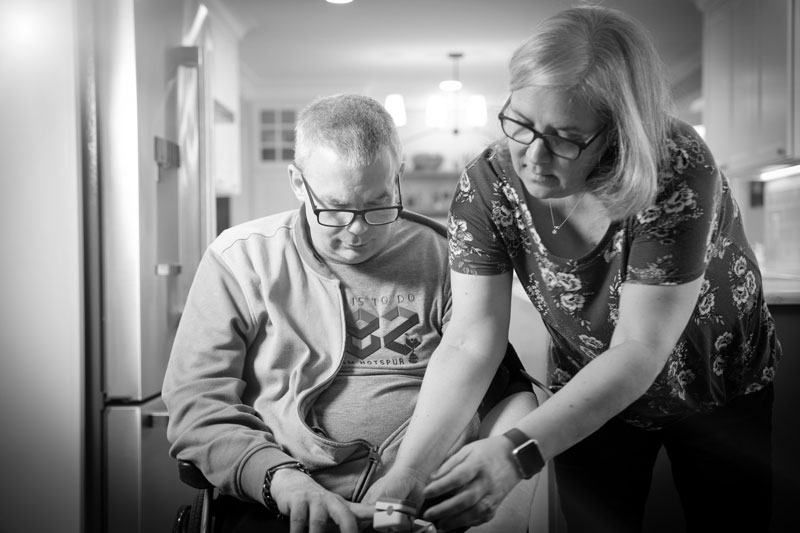
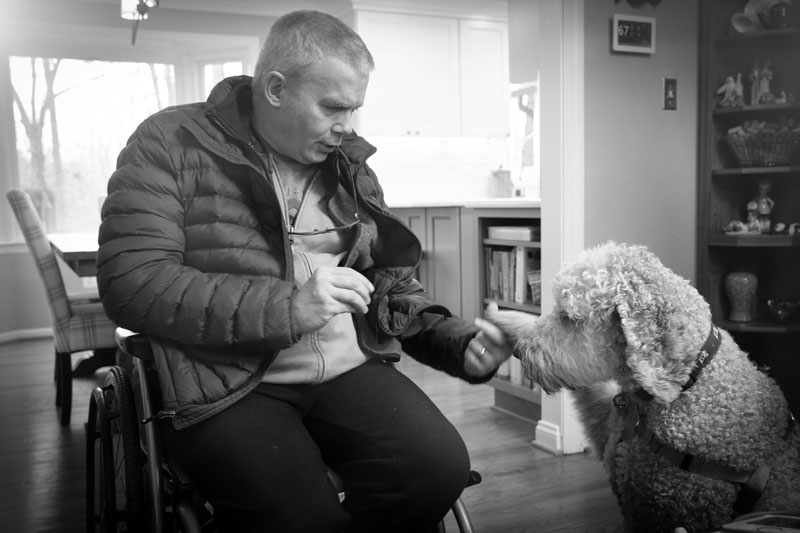
MSA is a condition that causes gradual and permanent damage to critical nerve cells in the brain. To Mike, “Living with MSA is a challenge because you never know the day or time when your involuntary systems are going to go out of whack. I was a high-level engineer at NASA and now I can barely balance a checkbook.” Mostly confined to a wheelchair, Mike wears a helmet to protect himself from the unexpected times when he passes out, about 50 – 80 times a month. A good day is when Mike is not bedridden, his blood pressure is somewhat under control, and he can use the bathroom without passing out. It’s a day when he can sit in a wheelchair without difficulty breathing, when he can speak without a mumble and when his constant tremors are tolerable.
What do you wish people knew about living with MSA?
Colleen has been caregiving for Mike since his symptoms began to appear in 2010 and his official diagnosis in 2020. MSA is usually fatal within 10 years, however, Mike’s symptoms were more gradual, and today are especially apparent. Unquestionably aware of the fate that lies ahead, Mike and Collen face every day with an unwavering appreciation for daily life. Good days or bad, Colleen takes on the daily responsibilities of every household chore knowing her spouse is unable to assist. She must also monitor and document Mike’s bodily functions every hour from sunup to sundown and even during sleep. Mike makes his regimen of pills abundantly clear proclaiming, “I’m on an ungodly amount of medication. For every single involuntary function my body has – I am on some type of medication.”
What are your hopes for the future?
Despite the many medical and resulting physical challenges that are a result of this devastating condition, Collen remarks, “What impresses me is how Mike faces MSA. It impacts every aspect of our lives, yet he has never let it define him. Deep down, he is still the same person that I first met and fell in love with.” Mike is well aware that his world is getting smaller as his MSA progresses and the care required continues to intensify. Speaking with admiration about his wife and caregiver, “a lot of people say this is too much, but Colleen has been my biggest advocate. I’ve never had to worry if she was going to be there for me. With no cure to directly treat MSA, our hope is that gene therapy can ultimately control the progression or one day provide a cure.”
For more information about MSA, visit Defeat MSA Alliance https://defeatmsa.org/ or Mission MSA https://missionmsa.org/.
Patient experiences and perspectives are personal and do not reflect clinical outcomes or the effectiveness of any investigational therapy.